English
 日本語
日本語 한국어
한국어 français
 Deutsch
 Español
 italiano
 русский
 português
 العربية
 Nederland

In food processing, cosmetics, pharmaceuticals, and industrial formulations, maintaining a stable mixture between oil and water components is a common technical challenge. Emulsifiers play an essential role in improving stability, texture, appearance, and product performance. Among widely used non-ionic emulsifiers, sorbitan mono stearate has become an important ingredient for many formulation systems due to its excellent emulsifying ability and compatibility with different raw materials.
Also known as Span 60 or emulsifier E491 in some commercial classifications, sorbitan esters are commonly used to control emulsion stability and improve processing performance. Sorbitan monostearate is identified as CAS No. 1338-41-6 and is classified as a food additive emulsifier (INS 491) by international food additive references.
For companies looking for reliable emulsifier ingredients, understanding the chemical properties, application areas, and supplier selection criteria of sorbitan mono stearate is essential. This guide explains how this emulsifier works, how it compares with other sorbitan esters, and how to choose a suitable supplier for industrial requirements.
Sorbitan mono stearate is a non-ionic surfactant produced from the esterification of sorbitol derivatives with stearic acid.As a key member of the sorbitan fatty acid ester family, it is widely recognized in the industry as an ideal choice for stabilizing water-in-oil (W/O) emulsion systems. Additionally, it serves as an effective co-emulsifier, significantly enhancing the stability of complex oil-in-water (O/W) systems.
The chemical structure of sorbitan monostearate (E491) contains both hydrophilic and lipophilic groups. This unique structure allows it to locate at the interface between oil and water phases, reducing surface tension and helping prevent separation.
The main characteristics of sorbitan mono stearate include:
Non-ionic emulsifying properties.
Good compatibility with oils and fats.
Strong stabilizing performance in low-water systems.
Thermal stability during processing.
Ability to work together with other emulsifiers.
Because of these properties, sorbitan monostearate is widely used in bakery products, fat-based formulations, cosmetics, pharmaceutical preparations, and industrial emulsions. It is commonly applied where stable texture, uniform dispersion, and longer product consistency are required.
The main function of sorbitan mono stearate is to help combine two normally incompatible substances, such as oil and water. Without an emulsifier, oil droplets tend to separate from water phases over time. Sorbitan monostearate creates a protective layer around dispersed droplets, improving the stability of the entire system.
One important factor influencing emulsifier performance is the HLB (Hydrophilic-Lipophilic Balance) value. Sorbitan monostearate has a relatively low HLB value, which means it has stronger affinity toward oil phases. This makes it suitable for water-in-oil emulsions and fat-based formulations.
In practical applications, sorbitan mono stearate is often combined with higher-HLB emulsifiers, such as polysorbates, to achieve balanced emulsion performance. The combination allows formulators to adjust stability, texture, and viscosity according to different product requirements.
Compared with ionic surfactants, sorbitan esters are non-ionic emulsifiers, meaning they are less affected by electrolytes and pH changes. This makes them suitable for complex formulations where long-term stability is important.
Sorbitan esters include several different products with different fatty acid chains and application characteristics. Selecting the right type depends on the required HLB value, formulation structure, and final product performance.
| Product | HLB Value | Main Applications |
| Sorbitan Monostearate | 4.7 | Bakery products, fats, W/O emulsions |
| Sorbitan Monolaurate | 8.6 | Food & cosmetic formulations, fragrance solubilizationFood and cosmetic formulations |
| Sorbitan Monooleate | 4.3 | Liquid oil-based systems, high-fat formulations |
In-depth Analysis of Performance Differences:
Compared with sorbitan monolaurate, sorbitan monostearate has a longer fatty acid chain, providing stronger oil affinity and better performance in fat-based systems. Sorbitan monolaurate is often selected for applications requiring different emulsification characteristics, especially in food and personal care formulations.
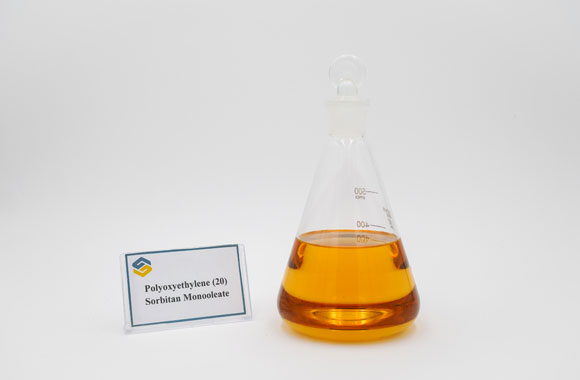
Sorbitan monooleate emulsifier is another important member of the sorbitan ester family. Due to its oleic acid structure, it provides excellent compatibility with vegetable oils and oil-rich formulations.
Choosing between these sorbitan esters requires evaluating the formulation system, processing conditions, and desired stability performance.
The versatility of sorbitan mono stearate allows it to be used across multiple industries. Its main value is improving formulation stability, preventing separation, and enhancing product consistency.
In the food industry, sorbitan monostearate is commonly used in bakery products, whipped toppings, confectionery, fat emulsions, and other processed foods. It helps improve dough handling, maintain texture, and stabilize fat-based systems.
In cosmetics and personal care products, sorbitan monostearate works as an emulsifier that supports stable creams, lotions, and skincare formulations. It helps maintain a smooth texture by keeping oil and water ingredients evenly distributed.
Pharmaceutical formulations may also use sorbitan esters as formulation aids because of their compatibility and emulsifying performance. They can help improve the stability of certain oil-containing preparations.
Industrial applications include lubricants, coatings, and other emulsion-based products where stable dispersion and processing performance are required.
For manufacturers, selecting the correct emulsifier type is important because different industries have different requirements for purity, stability, and regulatory compliance.
Choosing a reliable supplier is an important step for companies purchasing sorbitan mono stearate for commercial production. A qualified manufacturer should provide consistent product quality, technical support, and stable supply capability.
When evaluating suppliers, companies should consider several factors:
Production capacity and supply reliability.
Quality control procedures.
Product testing standards.
Technical support capability.
Custom formulation solutions.
A professional manufacturer such as Huana chemistry focuses on providing stable emulsifier products with strict quality management and production control. Reliable suppliers should have complete quality inspection systems to ensure that each batch meets customer requirements.
For industrial buyers, supplier selection is not only about product price. Consistent quality, delivery reliability, and technical communication are equally important factors that influence long-term cooperation.
A suitable sorbitan ester supplier should be able to support different application requirements and provide solutions according to formulation challenges.
Sorbitan mono stearate is mainly used as an emulsifier to stabilize oil and water mixtures. It is widely applied in food products, cosmetics, pharmaceuticals, and industrial formulations to improve texture, consistency, and stability.
Sorbitan monostearate has been evaluated by international food safety organizations as a food additive emulsifier. Its application should follow relevant regulations and recommended usage levels.
Emulsifier E491 refers to sorbitan monostearate, a non-ionic emulsifier used to improve the stability of various food and industrial formulations.
Sorbitan monostearate has a lower HLB value and stronger oil affinity, making it suitable for oil-based emulsification systems. Polysorbates generally have higher hydrophilic properties and are often combined with sorbitan esters to create balanced emulsifier systems.
Sorbitan monostearate is produced through esterification between sorbitol-derived compounds and stearic acid under controlled manufacturing conditions. The production process is designed to achieve consistent purity and performance characteristics.
When selecting a supplier, buyers should evaluate production capability, quality control, technical support, product consistency, and industry experience. A reliable supplier can help customers choose the correct sorbitan ester according to their specific application needs.